Round the Block

Tuesday, October 13, 2009

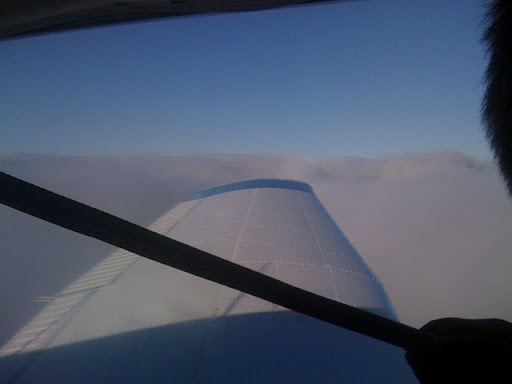
The standard training route for Instrument Rating training is PM-RUGVI-WU-FOXTN-PM, or Round The Block. A student of mine was due for a go at it, known as IN01 as part of the single engine IFR phase which is mostly in the sim and culminating in a sim check which is the equivalent of a single Engine Instrument Rating flight test. It's good for the instructor (me!) to be able to fly it for real too. It all helps for IFR currency. So, myself and student X piled into a trusty PA28 Warrior and climbed into the murk on a 25 ALFA 6 departure.We popped out of the stratus at around 4800ft. We spent the next 30 minutes skimming the tops at 5000ft en-route to a reporting point, RUGVI. It's a cliche but there's nothing more awesome than skimming the tops of clouds. You get a real sensation of speed, even if it is only 100kts! Left turn to track 226 to WU (Wanganui) NDB. Usually a couple of laps of the NDB hold but due to inbound Eagle B1900D traffic we were instructed to commence the WU NDB/DME 11 approach from the overhead. By this time we were down to 4000ft and back in the cloud. No worries, 'actual' is all good for the currency. Student X performed a pretty good approach. Then off to FOXTN for a couple of VOR holds at 6000ft.
Palmerston was reporting cloud at around 1500ft so again, lots of 'actual'. Awesome! After the second hold Ohakea cleared us for the VOR/DME 07 Circling 25 and gave us a radar vector for finals. Usually we'd get the 12DME arc but this wasn't available due outbound traffic. No problem, it's good experience for the student. We popped out fo the cloud around 1200ft at around 3 DME and then circled left for runway 25.

The flight was 2.0 hours long, 1.7 of which was actual. All good stuff for the logbook.

Mock CPL

Friday, October 9, 2009


  1. Max Performance Take-off
  2. Medium Turns
  3. Steep Turns
  4. Max Rate Turns
  5. Basic Stall
  6. Approach Stall
  7. Wingdrop Stall
  8. Stall in a Turn
  9. Unusal Attitudes
  10. Forced Landing Without Power
  11. Low Flying
  12. Line Feature Reversal Turn
  13. Coastal Reversal Turn
  14. Precautionary Landing
  15. Steep Gliding Turns
  16. Shortfield Landing
  17. Coffee........

To New Plymouth

Tuesday, October 6, 2009


Finally a good day for a visual nav to New Plymouth. The weather's been against us over the past couple of weeks, kinda frustrating! Airborne around 0830 to NZNP via Wanganui (NZWU) and Hawera (NZHA). A bit of cloud kept us below 3000ft until Waverley but the skies cleared enough for us to climb.

We needed to get to 6000ft or above as the students need experience navigating high level. A touch'n'go at Hawera then to New Plymouth via Stratford. I always like to grab a coffee at Airspresso at the New Plymouth terminal. Always good coffee. I let the kiddies re-fuel while I re-fueled.
We routed back to Palmerston North via Patea Dam and Jersualem which can be hard to find even on a good day. A bit of low cloud and light turbulence made the job a little harder for my student but he managed to find it (must be due to my superb flight instruction!). Total flight time there and back was 3.1 hours.

iPhone app

Tuesday, July 28, 2009

Nothing much. Trying a new blog app for iPhone.


-- Post From My iPhone

Shiny!

Tuesday, July 7, 2009


Last Thursday was the public enveiling of our new fleet of Diamond trainers. Guests from the RNZAF, Airways, the media and University big-wigs were in attendance. The weather for the big day turned out to be excellent, a light easterly and SKC.

We all assembled in the hangar for the addresses from the school's GM and the Vice-Chancellor of the University. The event was well catered, the meatballs were outstanding! Trying to avoid the media was the call as I was somewhat inconspicuos in my uniform. Eventually I was cornered by a reporter/DJ from the local ZM station. Typical stupid questions followed but I managed to bumble my way through it.

Did I mention how good the meatballs were?

The various media were taken for flights in 3 of the DA40's in the afternoon. Here are a couple of links to their stories.

TVNZ

NZ Herald

I'm due to convert to the DA40's in the second week of August. It will be a full-on week. The aircraft itself will not be difficult to fly, it's the G1000 avionics that make the biggest difference. After a VFR type rating we'll be straight into a TEA (Technically Enhanced Aircraft) Instrument Rating. Then I can say goodbye to the ADF! This IR is VOR, GPS and ILS only. Fantastic!

Another tick in the box

Tuesday, June 23, 2009

About a month ago I finished the 50 hours on an IFR flight plan requirement to teach IFR. I booked ZK-MBE for most of the day. Chris, one of my workmates, was keen to knock off some of his 50 hours too so we decided to fly to Gisborne. Chris would fly to NZGS and I would fly back. The weather was ok but a westerly change was forecast. This left the potential for turbulence in the lee of the Ruahine's on the way back. Fun and games in an underpowered 25 year old light aircraft!

We planned for NZGS:

PM-WEBER-NR-WO-GS


Pre-flight planning and pre-flight complete, Chris, Dan and myself headed out to our aircraft. Cleared to NZGS via flight planned route at 7000 ft. After the standard run-ups and checks we departed off runway 25 and climbed away to the east.


Turning right onto track


Climbing through 2600 ft


Nearing WEBER we turned left to track overhead NR VOR and then onto WO and NZGS. The weather was fantastic with outstanding visibility and few clouds. However we could see lenticular clouds forming high over the ranges. a sign of the impending westerly change.


Fairly quiet in the cruise so Chris briefed himself on the approach at NZGS. He was keen on the VOR/DME 32 approach, via the overhead, for currency (3 hours IF, 3 approaches, 3 months). NZGS was reporting a light northerly and sky clear.


Overhead NR we then tracked to the Wairoa (WO) NDB. NR tower instructed us to contact GS tower at WO and cleared us to descend to 6000 ft. We heard a Skyline Aviation PA31 get airborne from NR heading to GS at 5000 ft. He was on the same track as us so the 6000 ft descent limit allowed for 1000 ft separation.


The east coast of the North Island is essentially all procedural airspace, that is non-radar. Because of this ATC will use precautionary holds and timed arrivals to separate traffic. Two IFR aircraft arriving within a few minutes of each other at GS gave the tower controller a bit of work. We called him overhead WO as instructed.


The PA31 that was on the same track as us called after us. He was about to "undertake" us (180kt vs. 100kt!). Tower cleared him for descent after he requested a visual approach with the condition that he report leaving every 1000 ft on his way down. This would enable tower to give us descent and ensure separation. Chris requested the VOR/DME 32 approach. We were cleared as requested, via the overhead. When the PA31 reported out of 4000 ft we were cleared to 5000 ft.


Down the 3000 ft as the PA31 cleared 2000 ft we tracked on the GS VOR in preparation for the approach. This teardrop approach would take us out into the bay for 5.5 DME and then a right hand base turn to track inbound and lined up with runway 32. MDA is 420 feet.


Tracking outbound


Inbound. See the runway?


An uneventful landing ensued. GS is quite unique as there is a railway line going through the runway. The railway was there first so I guess that's the way it's got to be! After a brief coffee and a bit of cake at the airport cafe (very good BTW. They use Havana coffee and make a fantastic long black) we headed back to the plane to take it back to NZPM. This was my leg. I filed the plan through the NBO on the 0800 number. We were to route the opposite way back to NZPM at 8000 ft. Start, run-ups and checks complete we were cleared to PM via flight planned route at 8000 ft and cleared a right visual departure to cross overhead the VOR at or above 1500 ft due to circuit traffic.


Standard takeoff followed by the right hand turn I established on track. As we were in non-radar airspace once established on track I called tower and told them I was established, climbing to 8000 ft and gave an ETA for WO. At WO I was instructed to call NR tower. That was easy. A bit further down the track I could see the size and extent of the lenticulars had increased, so I prepared for some mountain waves a bit further south.


Passing overhead NR I could see a definite mountain wave. It was going to be interesting near WEBER. Sure enough approaching WEBER the up and down drafts started. Not too bad but I thought we'd be better a little lower. I asked Ohakea control for a block clearance 6-8000 ft. They obliged. I managed to pick up the PM ATIS. They were reporting BKN at 2500 ft and 30 km visibility. But there was a big bank of cloud between us and PM so I prepared for the VOR/DME 25 approach. Turning towards PM from WEBER the ground speed dropped to around 50 kts! We were heading straight into a 50-60 kt westerly! It was going to take a while to fly the 40-odd nm to PM. At least it was smooth at 6000 ft. Anticipating rough air nearing the ranges I tightened up my seatbelt straps. Luckily it remained smooth and we finally made it onto the approach.
From start to engine off had taken 2.3 hours compared with 1.8 for the trip up.

I now had over the 50 hours required and was therefore an IFR instructor (after I got it signed off by an A-Cat).

Next on the list is the Multi Instructor ticket......

not much going on today....

Friday, May 22, 2009


PALMERSTON NORTH (NZPM):

METAR NZPM 212200Z 12003KT 30KM FEW030 BKN035 BKN045 07/04 Q1020=

TAF NZPM 212135Z 2121/2212
23008KT 20KM -SHRA BKN030
TEMPO 2121/2212 5000 SHRA
2000FT WIND 25015KT
BECMG 2122/2124 18025KT =


Forecast: issued 20:32pm 21-May-2009 (UTC)
Aviation Situation SFC:

Cold S/SW flow covers NZ. Front moving northeast over NI, clearing tonight.
UPPER: Low to E of NZ. Strong westerly jet intensifying over Far North.Southerly
jet mov E over SI.
TURB: Ocnl mod blw FL100 over North Island S of NZWP and abt Cook Strait, may
become severe,sigmet possible.

Ocnl mod blw FL120 over South Island, SEVERE AS PER SIGMET.
Ocnl mod FL200/400 N of NZRO, may become severe, sigmet possible.
Ocnl mod FL280/350 N of NZWU S of NZRO, easing afternoon.

Ocnl mod FL280/350 N of NZTU/NZMC S of NZWN developing afternoon.
CB: Nil sig.
ICE: Ocnl mod 4000ft/FL150 N of NZTU/NZMC S of NZAA.
Aerodromes to Watch :
NZWP NZOH